It's no wonder it's called the Canticles of Canticles.
A couple of years ago, I attended a workshop given by a priest on Lectio Divina, an ancient way of reading and meditating on the Scriptures. He asked us, "which book of the Bible is the lens through which every other book can - and should - be read?" We guessed - "is it Genesis?...Revelation?..." "No," he said. "It's the Song of Songs." The older I get and the more often I contemplate Solomon's Song, the more I see the truth in this.
"I slept, but my heart was awake.
Hark! my beloved is knocking.
'Open to me, my sister, my love,
my dove, my perfect one;
for my head is wet with dew,
my locks with the drops of the night.'
I had put off my garment,
how could I put it on?
I had bathed my feet,
how could I soil them?
My beloved put his hand to the latch,
and my heart was thrilled within me.
I arose to open to my beloved,
and my hands dripped with myrrh,
my fingers with liquid myrrh,
upon the handles of the bolt.
I opened to my beloved,
but my beloved had turned and gone.
My soul failed me when he spoke.
I sought him, but found him not;
I called him, but he gave no answer.
The watchmen found me,
as they went about in the city;
they beat me, they wounded me,
they took away my mantle,
those watchmen of the walls.
I adjure you, O daughters of Jerusalem,
if you find my beloved,
that you tell him
I am sick with love."
- The Song of Solomon 5: 2-8, RSV
Tuesday, December 22, 2009

Friday, December 18, 2009
An act too often neglected...

I've always been a fan of C. S. Lewis' portrayal of the Divine: as Something that is beautiful and wonderful, but also wild and sometime intimidating. Aslan is a lion, and, as a character points out in The Lion, the Witch, and the Wardrobe, he's not a tame lion. Furthermore, not only is God great, but - as it would follow - we are small, mild, and quite timid in comparison.
My first point here is that I find the image of myself as a small creature before a great Lion very useful - it puts things into perspective on a day-to-day basis, and helps me remember how I truly relate to the rest of the universe.
This is leading up to my BIG point: that, in spite of all this, I'm still in love with Antoine de Saint-Exupery's idea of the human person as a wild creature that must be "tamed" by another human through the connection of love.
In The Little Prince, it is when the title character encounters a wild fox that Saint-Exupery presents his philosophy on the process of "taming". In the words of the fox, it is "'an act too often neglected...it means to establish ties.'" Speaking to the Little Prince, he says: "'To me, you are still nothing more than a little boy who is just like a hundred thousand other little boys. And I have no need of you. And you, on your part, have no need of me. To you, I am nothing more than a fox like a hundred thousand other foxes. But if you tame me, then we shall need each other. To me, you will be unique in all the world. To you, I shall be unique in all the world...'" (pg. 66). How lovely!
Let's look, for a moment, at the dictionary definition of the adjective tame. The first definition offered on Dictionary.com is "changed from the wild or savage state; domesticated". I think this is probably what comes to most people's minds at the word "tame" - we get an image of the caged bird, or the chained-up wolf - a creature that has been deprived of something; its freedom, perhaps?
But check out the second definition: tame means "without savageness or fear of humans normal in wild animals; gentle, fearless, or without shyness, as if domesticated". The tamed creature not only loses its wildness; it loses its fear of the person by whom it was tamed. Why? Because it has learned to trust that person. In a sense, then, are not tamed - trustful - creatures truly free? And aren't we (humans) just like wild animals when it comes to relationships? We've all been hurt by the hunters, with their bullets, lures and trappings; but we must allow the desire for intimacy to overcome the fear of injury if we wish to discover the Little Princes in the world.
There are days when I love to feel wild - especially in autumn, when the weather's usually at its most unruly and glorious. But, just like Max in Where the Wild Things Are, I wouldn't want to feel wild all the time; there's a sort of loneliness that inevitably accompanies wildness. I would hate to reach the end of my life and realize that I'd never been tamed.
Cited in this post: The Little Prince. Antoine de Saint-Exupery. Reynal & Hitchcock (New York): 1943.
Wednesday, December 16, 2009
On my Christmas break bookshelf

Now that I'm home from college, I'm finally finding time again to actually read. It feels wonderful! Here's what I'm munching on right now.
Surprised by Joy by C. S. Lewis
Lewis wrote so many things, and I love him so much, that it seems like I've been constantly reading something or other by him for the past three years or so. This actually isn't turning out to be my favorite of his non-fictional works, but I'm enjoying it all the same. It's enlightening to be able to learn about the events in his childhood and early adulthood that influenced his inner development and led to his conversion, and to read first-hand about all of the intriguing characters who inhabited his life.
Brideshead Revisited by Evelyn Waugh
I'm only on chapter three, but I love it already. The Catholic theme is already apparent to me, and I can't wait to see how that's going to develop. Once I've finished it, I'd like to see how the two film adaptations compare - I've heard that the '81 mini-series is quite good, while the '08 film kind of falls short of the book (and is anti-Catholic, to boot. Go figure). Right now, I'm loving the character of Sebastian Flyte. I don't know if I will the whole way through - I still don't know what his back story is, or how he will develop - but he totes around and talks to a teddy bear named Aloysius. He has my heart.
Sunshine by Robin McKinley
McKinley - one of my favorite contemporary fantasy authors - has constructed a world where vampires and other ghastly creatures run loose and frequently terrorize the human population, kept in check only by a sort of anti-monster police force. In this world, vampires are ugly and entirely unappealing, not to mention terrifying - a nice change from the world of Twilight. Dark humor sets off the suspense and gore: the narrator is a shrewd, determined young woman (like most of McKinley's heroines) who also has a sarcastic take on every situation encountered. This definitely isn't my favorite of her books; Rose Daughter and even The Hero and the Crown both had more emotional depth and more enduring themes than this new novel. I find this interesting, seeing as Sunshine is supposedly McKinley's first "adult" work. The only things that this has more of in comparison to her YA novels are language and sleaze.
The Wind in the Willows by Kenneth Grahame
A part of me is sad that I didn't read this as a little kid, but at the same time I'm so glad I'm reading it now, from a young adult's perspective. The older I get and the more I read, the more firmly I believe that any children's book written by an adult will always be more than just a children's book. Something that immediately struck me when I began reading The Wind in the Willows was how sensual some of the imagery is - in a good way, of course, but also in a very mature way, that makes the mind stretch. I'm talking about even just Grahame's description of a river. He has a lovely way with words. It's amazing. I'm so in love. Gah.
Edited by John F. Thornton and Susan B. Varenne
There's a reason this guy was called the "Mellifluous (honey-sweet) Doctor". He writes simply - a 12-year-old would have no trouble understanding him - but with such incredible SWEETNESS. He's amazing. This book contains selections from his sermons, letters, and other writings. My favorite part is the selection from his sermons on The Song of Songs. I forget how large the collection is, but this books contains the first 23 sermons. They are gorgeous. The end.
Winter really does bring out the Hobbit in us all - there's nothing better than to snuggle up indoors with a good book when the weather's cold and stormy. What are you reading this winter? Feel free to share in the comment box!
Happy Advent,
Olivia
Sunday, December 13, 2009
Splendid and Von Hildelicious

Naturally, I'm talking about something written by the great Alice Von Hildebrand. Her essay "On True Love", which was released last August, can be found here.
What I love best about this essay is that Hildebrand doesn't simply write off the feeling of "being in love" as dangerous, misleading, or even transient. Rather, she displays a firm advocacy for the human heart, and points out that emotion at its purest and noblest is strong enough to lead us to do what's right - what's responsible - what makes sense. "The heart is not only on fire, but this fire has a melting effect." Oh, what sweet news for all of us romantics!!
I guess it just goes to show that Romance and Reason really are compatible! After all, C. S. Lewis - with his elaborate theories on Sehnsucht and Longing - greatly respected G. K. Chesterton, the ultimate "apostle of common sense". The two are kind of like cheese and apples - they're surprisingly yummy together, yes?
Friday, July 24, 2009
Doctor Who Excitement!

I’m referring to my reaction to some news about the upcoming series 5 of Doctor Who. I realize that this is pretty old news (it was released back in May, and I didn’t even know it!), but I still want to blog about it.
As I’ve probably observed a thousand times: over the course of 46 years and 11 incarnations, the Doctor seems to have gradually become both younger and hotter. William Hartnell was 55 when he began his career as the First Doctor, and Matt Smith, who will portray the Eleventh Doctor in Series 5, is only 26 – the youngest Doctor to date. Needless to say, Doctor Who’s target audience has shifted, over the years, from kids and hardcore sci-fi geeks, to adults in general; especially young adults. (No, not just “young women”, because hey – the Doctor’s female assistants have always been more-or-less young and pretty.)
In general, I’m okay with all this – after all, neither an actor’s age, nor his level of attractiveness will affect how well he can portray everybody’s favorite Time Lord. If a guy can act and look good at the same time - I say, all the better! But I’m a little concerned about what this upcoming season will bring in regards to the Doctor – and relationships.
When the TV series first started out, the Doctor was portrayed as an almost asexual being: the writers generally avoided allowing the Doctor to become romantically involved with his female assistants, regardless of the fact that the two always lived together in the TARDIS. For this reason, I love the early incarnations of the Doctor – I think the “no romance” policy lent such an air of mystery and other-ness to his character.
This policy was (most significantly) discarded in season 2 of the new series – although they never kissed or spoke explicitly about the nature of their relationship, Doctor #10 and his assistant, Rose Tyler, obviously had a thing for each other. Now, there are things that I like about this arrangement, too. It raised an important question: though the Doctor isn’t human biologically, does he have a human heart and soul? Given his staggering age and amount of life experience – not to mention the sheer responsibility of being the protector of the universe – is he capable of loving a woman the way a human man can love? This is a question without answer – ardent Whovians will be able to conjecture for forever…and ever…
So, what kind of relationship do I want the Eleventh Doctor and his new companion, Amy Pond, to have? To be honest, I want it to be entirely platonic. I mean, in all truth, there is already plenty of chemistry in a close-knit boy-girl friendship. After all the sadness and turmoil of #10/Rose – not to mention poor Martha’s season-long unrequited love story – I’m ready for something a little lighter. I can’t wait to see what Russell T. Davies delivers!
All of this being said, I just have to add something about HOW MUCH I LOVE #11’s outfit. Bow tie + suspenders + tweed jacket = dorkalicious excellence.
Oy…2010 is wayyyyy too far away…
Tuesday, July 14, 2009
Book Review: The Magical Land of Noom by Johnny Gruelle
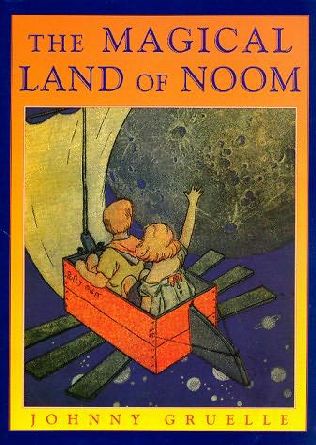
Any book with character names like “Jingles the Magician” and “Mr. Tiptoe” has just got to be good.
Here’s the first of – as I anticipate – many Obscure Literary Gem posts. American children’s author Johnny Gruelle is probably best known for his Raggedy Ann and Andy books, but this 1922 fantasy adventure certainly deserves some attention.
The Magical Land of Noom resembles, in many ways, L. Frank Baum’s acclaimed The Wonderful Wizard of Oz, but not to fear: the former easily holds its own. Set some two decades after Oz, Noom has that irresistible 1920’s charm about it, and also has (in my opinion) a warmer feel – after all, Oz is the story of an unusually independent little girl who doesn’t begin to miss her home until she’s traveled in a strange land for quite some time. Noom centers on a young brother and sister who help and protect each other while sojourning in the Unknown, and who are soon joined in that adventure by their “Gran’ma” and “Grand’pa”.
Johnny and Janey are innocently playing in the yard one day, when the idea strikes them to build a Flying Machine. It’s constructed, soon enough, out of old boards and nails, and they name it Polly Ann. They climb inside to try it out – but hold on, Johnny and Janey! This Flying Machine can actually Fly!! Before they know what’s happening, they’ve zoomed into the sky and landed on the side of the Moon that we never see – hence, the name Noom.
Getting worried about their beloved gran’kids, Gran’ma and Grand’pa quickly construct a boat that (like Polly Ann) has unusual, enigmatic flying powers. They join Johnny and Janey in Noom, and the real adventure begins.
Noom seems like a lot of fun: giant gingerbread mushrooms, lemonade streams, and cute little Faun Boys abound…but there is also a swarm of bloodthirsty boxing gloves, a violent ink rainstorm, and the evil Old Jingles the Magician (who’s actually a lot more menacing than he sounds). By various turns of events, both of our protagonists’ flying vehicles become unavailable to them – but even if they had been able to fly straight home after a little visit to the land-on-the-other-side-of-the-Moon, they probably would have had to stick around anyway and help all of their unfortunate new friends solve their problems: there’s a Beautiful Girl in an enchanted Green Jar, the Queer Horse (whose head has become invisible), and the royal Dancing Master, Mr. Tiptoe, who is searching for his long-lost pupil (and who may be a little lost, himself).
Anyway – everything comes together in the end, just as it should and just as it always does. The Magical Land of Noom is satisfying and nostalgic, if a tad predictable. It’s like the comfort food of children’s fantasy stories. Plus, the illustrations are absolutely DELIGHTFUL – they are Gruelle’s own work (and in that way, at least, he certainly one-ups Baum!).
So whatcha waiting for? Find yourself a copy and get Noomed.
Thanks for reading!
Cited in this post: The Magical Land of Noom. Johnny Gruelle. Books of Wonder (New York): 1998. 158 pages. $22.00.
Monday, July 13, 2009
The best edition of "Snow-White and the Seven Dwarfs"...

...is definitely the one illustrated by Nancy Ekholm Burkert.
The artwork is simply enchanting, and the text is a beautiful translation of the original tale by the Brothers Grimm.
Beside the magnificent illustrations, there are so many little things I love about this translation by Randall Jarrell.
For one, there's the part where the bite of apple is stuck in Snow-White's throat, and her coffin is jolted while the dwarves carry it; the piece of apple flies out of her mouth...and she wakes up.
And then there's the amazing exchange between SW and the king's son that takes place once she's awake.
"'Oh, heavens, where am I?' cried she. The king's son, full of joy, said: 'You're with me,'..."
And, of course, there's the delightfully creepy conclusion: "...they...put iron slippers over a fire of coals, and they brought them in with tongs and set them before her [the wicked Queen]. Then she had to put on the red-hot slippers and dance till she dropped down dead." AND EVERYBODY ELSE LIVED HAPPILY EVER AFTER!!! :-) There's even a great illustration to go with the slippers bit.
Anyway...go find a copy for yourself! It's a must-read.
Cited in this post: Snow-White and the Seven Dwarfs. By Jacob and Wilhelm K. Grimm. Translated by Randall Jarrell. Sunburst Books: 1987.
Subscribe to:
Posts (Atom)