Showing posts with label song of songs. Show all posts

Tuesday, May 22, 2012

Love and the soul

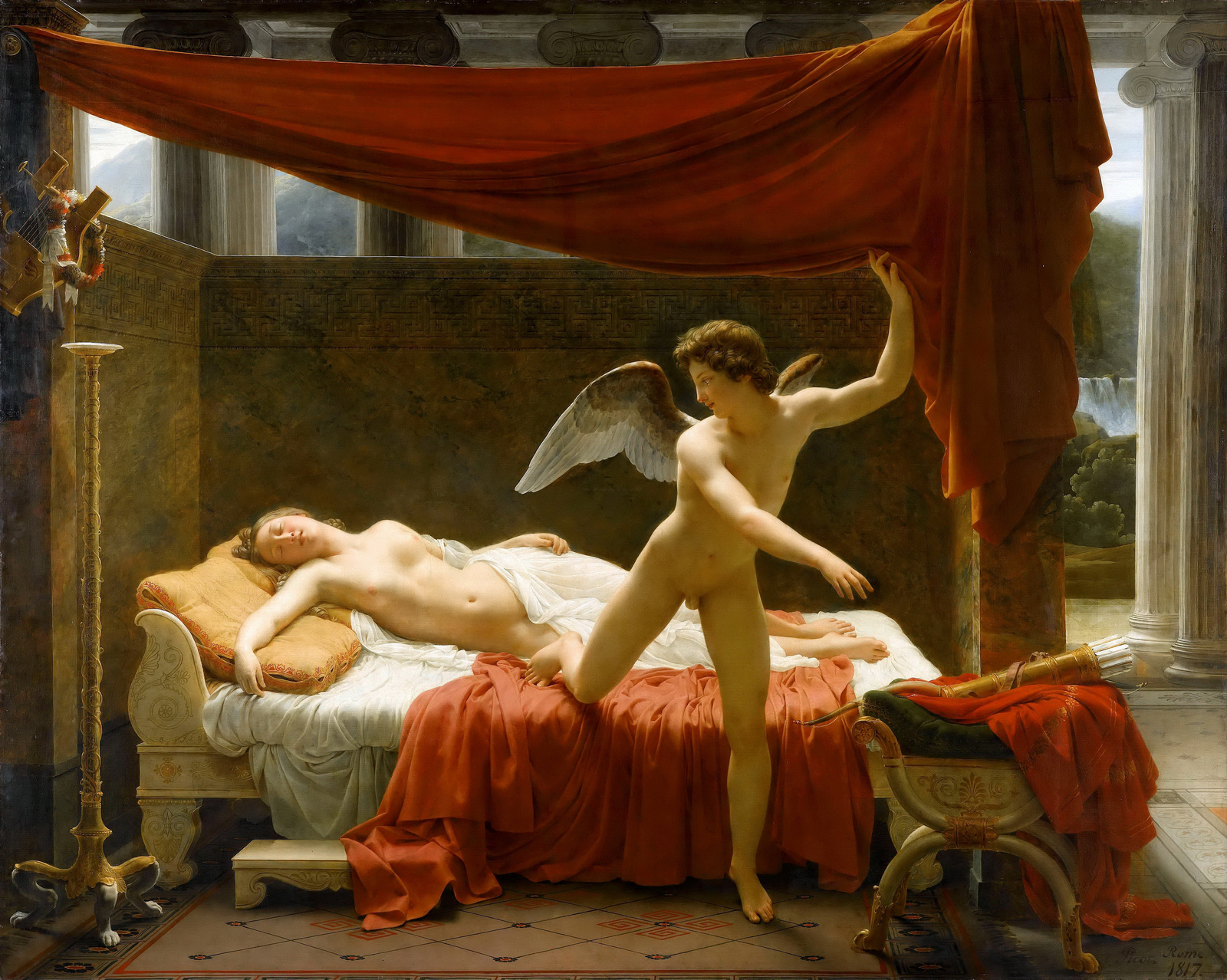
image source: wikipedia.org

I came across this image in a little booklet of angel-themed postcards: J. F. Picot's L'Amour et Psyché.


The general English translation is "Cupid and Psyche", which brings to mind all sorts of things - the original Greek tale, certainly, but also C. S. Lewis' masterpiece, Till We Have Faces.  But as I look at that French title, it is the radical that strikes me (as the radical sometimes does).

What is the direct translation of 'L'Amour et Psyché'?


Love and the soul.


That's You and me, I thought.

That's each of us and Him.

That story was reality before the ancient Greeks ever dreamed of it.  And, in reality, Love is much more than merely a mischievous, winged boy.  He descended to earth and became man for us, and then he sacrificed himself for us, "his heart an open wound with love."  He gave his body for us, and made it so that, while we wait for him to return, we may eat of his body and drink of his blood every day, and draw strength and sanctity from it: that, by taking him into ourselves, he may take us up into him, transforming us, making us into true lovers, worthy of having been made in his image and likeness.

How good it is, to have been given a reality sweeter than the wildest dream, more wondrous than the most fantastic of fairytales.

O that you would kiss me with the kisses of your mouth!  For your love is better than wine...
(Songs 1:2)

Tuesday, June 15, 2010

"Are not all lifelong friendships...

...born at the moment when at last you meet another human being who has some inkling (but faint and uncertain even in the best) of that something which you were born desiring, and which, beneath the flux of other desires and in all the momentary silences between the louder passions, night and day, year after year, from childhood to old age, you are looking for, watching for, listening for? You have never had it. All the things that have ever deeply possessed your soul have been but hints of it—tantalizing glimpses, promises never quite fulfilled, echoes that died away just as they caught your ear. But if it should really become manifest—if there ever came an echo that did not die away but swelled into the sound itself—you would know it. Beyond all possibility of doubt you would say "Here at last is the thing I was made for." We cannot tell each other about it. It is the secret signature of each soul, the incommunicable and unappeasable want, the thing we desired before we met our wives or made our friends or chose our work, and which we shall still desire on our deathbeds, when the mind no longer knows wife or friend or work. While we are, this is. If we lose this, we lose all." - C. S. Lewis, The Problem of Pain

So, I was just googling this quote - an absolute favorite of mine, by the way - to see what sort of results would come up. One of the first results was an excerpt from some guy's blog. He quoted just the first sentence, and then followed up with 'yeah, man, I just love those kinds of friendships!' (I paraphrase).

I was like DUDE. Lewis is not talking about friendship. He's talking about LONGING!!! And not just ANY longing - THE longing!!!! The one that we all experience, all of our lives - at least, Lewis believed that we did.

Isn't it strange? If this is something so very fundamental, something we all go through, and perpetually, why don't we ever hear about it?? Why haven't our artists been writing, painting, composing, and dancing about this constantly since the beginning of human civilization? Oh, of course little hints of it pop up just about everywhere; but it seems that our culture is just too emotionally prudish to discuss it explicitly, very often. Naturally, there's Lewis - it pervades everything he's ever written. As he details in Surprised by Joy, this inexplicable longing is what both defined his childhood, and ultimately led him to Christianity. There's also the mystics of the Catholic Church, of course. Read John of the Cross's Dark Night of the Soul - enough said. Read Bernard of Clairvaux on the Song of Songs for what it really means when the bride flies through the streets at night, searching for her Beloved. And, strangely enough, the most recent place where I have found an inkling of this is in Kenneth Grahame's The Wind in the Willows – go figure; I'm not sure what the connection is. But here's my point: all of these sources are very few and far between.

Now, I've tried to broach this topic with others many times in the past. I've tried to express my own experiences of this divine longing (like Lewis, this is something I've had since before I can remember. It basically defines my life, my person, and my entire existence.). I always observe my own words fall heartbreakingly flat, but I don't stop trying. Nine times out of ten, what is the response? Shifty eyes and awkward silences. Yeah, I'm sure I deserve it if people think me a little bit insane. But the longer I keep going, the more I realize that maybe I'm not the insane one. Essentially, insanity is a failure to adhere to reality. This longing is very, very real.

This has got to be one of the biggest elephants in the room...in the history of the world. Except it's more than that. I believe that, simply because it is such a difficult subject to discuss, we've given up. And, with the ceasing of our efforts to express it, we've begun to forget it, too.

I believe that our culture is coming very close to "losing all".
Tuesday, December 22, 2009

The most beautiful words ever written, spoken, read...

It's no wonder it's called the Canticles of Canticles.

A couple of years ago, I attended a workshop given by a priest on Lectio Divina, an ancient way of reading and meditating on the Scriptures. He asked us, "which book of the Bible is the lens through which every other book can - and should - be read?" We guessed - "is it Genesis?...Revelation?..." "No," he said. "It's the Song of Songs." The older I get and the more often I contemplate Solomon's Song, the more I see the truth in this.

"I slept, but my heart was awake.
Hark! my beloved is knocking.
'Open to me, my sister, my love,
my dove, my perfect one;
for my head is wet with dew,
my locks with the drops of the night.'
I had put off my garment,
how could I put it on?
I had bathed my feet,
how could I soil them?
My beloved put his hand to the latch,
and my heart was thrilled within me.
I arose to open to my beloved,
and my hands dripped with myrrh,
my fingers with liquid myrrh,
upon the handles of the bolt.
I opened to my beloved,
but my beloved had turned and gone.
My soul failed me when he spoke.
I sought him, but found him not;
I called him, but he gave no answer.
The watchmen found me,
as they went about in the city;
they beat me, they wounded me,
they took away my mantle,
those watchmen of the walls.
I adjure you, O daughters of Jerusalem,
if you find my beloved,
that you tell him
I am sick with love."

- The Song of Solomon 5: 2-8, RSV

Monday, December 29, 2008

Welcome!

…to Splendid and Delicious, my new blog.

The blog title was inspired by the writings of St. Bernard of Clairvaux, a French Cisterian monk of the 12th century, and a Doctor of the Church. In his first sermon from On the Song of Songs, he invites us to delve deeper into the beautiful book of poetry that represents the love between God and the soul:

“Solomon has bread to give that is splendid and delicious, the bread of that book called the Song of Songs. Let us bring it forth then if you please, and break it.”

This blog is devoted to breaking that bread - to rediscovering in daily life the splendidly delicious love God has to offer.

Here, you will find musings on art – literature, in particular – from the perspective of a young, aspiring Catholic artist. I’m going to try to review some current releases of book and film, etc.; but many of my reviews will also be of older and lesser-known gems. Stay tuned!

Thanks for visiting, and a Merry and Blessed remainder of the Christmas season to you!


Cited in this post: Honey and Salt – Selected Spiritual Writings of Saint Bernard of Clairvaux. Edited by John F. Thornton and Susan B. Varenne. Vintage Spiritual Classics (New York): 2007. 425 pages. $13.95.